Birds
by deri••0 views
BIRDS
Chapter 1
In the past, I used to wonder how much worse the world could get. Massacres, wars, hunger, murders, and dozens, even hundreds of other devastations—yet our beautiful home had endured remarkably well.
It was precisely while these thoughts occupied my mind that we decided to carry out our great action against those who believed the world belonged solely to humans. We planned a simultaneous attack on all major companies conducting experiments on animals, hoping it would resonate in the media.
I was the one who prepared the Molotov cocktails for our region. It had been easy to obtain sulfuric acid, gasoline, and paraffin. However, finding that many glass bottles required considerable effort. Thankfully, Pigeon Selim came to my rescue.
Pigeon Selim was an older man who lived a reclusive life. We called him Pigeon because, as you might guess, he had no one but his pigeons. He even resembled a pigeon. His thin neck looked as if it could snap with a single movement. He was a frail man. He rarely spoke to anyone and spent all his time with his pigeons. Sometimes he would go out to buy feed and medicine for them, or groceries for himself, and then quickly return home. He only greeted me. Even when greeting, he wouldn’t look me in the eyes; he’d just nod slightly with his head down and move on.
That day, when he saw me rummaging through the trash, he approached with his head down and asked, "What do you need?" Thrilled that he was talking to me, I blurted out, "Glass bottles," without even worrying about revealing our secret. "Come," he said quietly. He gave me two sacks full of beer bottles from the roof of his house. He didn’t say a word. He turned his back and left. He didn’t even look back as I carried the sacks away.
A week before the action, on the planned day, we stationed ourselves at the homes of friends closest to the target companies. We didn’t want to risk getting stuck in traffic or facing other obstacles. To avoid a police blockade in case of a leak, we had to eliminate all potential hindrances. For a week, we conducted surveillance. Where were the entry and exit points? Who came and went at what times? When did the workers clock in—we couldn’t harm any living being, so we couldn’t act during their shifts. How many security guards were there, and where were they stationed? We reviewed dozens of such details. Finally, we set the time. At exactly ten o’clock, we would attack from the front entrance. There were two private security guards, and we planned our actions to ensure they wouldn’t be harmed. We would carry only as many Molotovs as we could fit in our backpacks and avoid drawing attention until the last moment.
Because we kept our plans so secret, no one knew about the action until it happened, and we didn’t encounter any police interference during it. With our action, we managed to draw at least some attention to the companies conducting experiments on animals. Many companies suffered financial losses. The police arrived only after we had finished. We were still chanting slogans in front of the companies. Of course, we were all detained. In addition to detention, dozens of lawsuits were filed against us. Some are still ongoing.
In the days that followed, we received support from only a very small portion of the public. The vast majority didn’t care. Worse, some even supported the cruelty being perpetrated. But the greatest harm came from those who remained indifferent.
As we continued our struggle in one way or another, something happened that no one could have anticipated that day. All the news channels were reporting it non-stop. "What’s going on?"
The birds... The birds had started chirping madly all over the world. It wasn’t chirping so much as screaming. Pet birds, parrots, sparrows, crows, tropical birds, even chickens and penguins. Their cries filled every corner. Some people shouted, "Someone shut them up," while others worried about what was happening.
It was as if they were in pain, as if someone was choking them, as if they couldn’t breathe. As if someone was tearing off their wings, plucking their feathers alive. The sound was so intense and deafening that it could make ears bleed.
Their cries lasted exactly twenty-four hours. Then, suddenly, as if cut by a knife, the sounds ceased completely. Not a single bird sound remained. The world plunged into silence. It was impossible to understand why they had started or why they had stopped. Moreover, this inexplicable event had begun and ended simultaneously across the globe.
Experts explained that birds chirp for two reasons under normal circumstances. The first reason, they said, is the simplest: to choose a mate or call their friends. The second reason was more intriguing. "This is my territory, I will protect my family, and I’m willing to fight for it." However, they said it was impossible for all of them to do this simultaneously worldwide. There had to be another reason, an unforeseeable and terrifying one. It didn’t take long for us to understand the terrifying part. That morning, some people noticed the reason for the silence on Earth before the rest of us. Bird watchers, those with pet birds at home, and people who wanted to throw bread to seagulls. They were the first to notice something strange. On social media, everyone was asking each other the same question, and the wave was growing like an avalanche. The birds were gone. Every single bird had vanished at once. Sparrows, crows, parakeets—none were left. Not even chickens...
Chapter 2
The world had turned into a scene of chaos. News was pouring in from all over the globe. This horrifying event wasn’t confined to a single country; it was happening everywhere. Colombia, known as the bird paradise of the world, was announcing emergency action plans on television, trying to figure out where the birds had gone. Australia, Antarctica, New Zealand, South Africa, South America, and the Galapagos Islands were issuing statements expressing concern about penguins. Not just protected species, but all birds had disappeared.
No one trusted their government, and everyone was demanding an explanation as soon as possible. The United Nations announced they would do everything they could to understand the situation. Emergency Research Committees (ERCs) were established in every country as part of an emergency action plan. These committees consisted of ecologists, ornithologists, biologists, geologists, and other scientists. These experts came together and spent weeks trying to figure out what was happening. The theories they proposed were hardly convincing. Some linked it to the rotation of the Earth’s core. Others claimed it could be due to overheating magma, then global warming, or shifts in climate zones. But the birds hadn’t died or migrated. They had all disappeared at once, leaving no trace behind. All the countries were blaming each other, yet no one could produce even a slightly plausible theory to locate the birds. Public anxiety was growing, and people were blaming biological weapon experiments. Ultimately, the public grew restless and began producing various conspiracy theories. Some called it the apocalypse, others blamed aliens, and some pointed to human actions, like the massacre of seventy thousand starlings in Morocco for damaging olive crops. Another group simply said, "What’s meant to happen will happen." The only undeniable truth was that the birds had somehow disappeared, and none of us knew why.
Special research teams were dispatched worldwide under the leadership of the ERC. Caves, mountains, forests, and any place untouched by humans were all to be investigated. We all waited for news from them. Even though we knew it could take months or even years, we wanted answers quickly. As time passed, the absence of birds became more noticeable. Their songs were gone, their wingbeats silenced.
Suddenly, a rumor began circulating. It was said that a weapon called the DBLS Project had physically eradicated the birds. The project’s name, derived from the Latin word "Diabolus" meaning "devil," was designed to eliminate a species from the Earth without leaving a trace. The conspiracy theory claimed that DBLS had been tested on birds and that humans were the ultimate target.
The absence of birds led to uprisings, especially among environmental groups and the general public. As if the mass killings caused by wars, power struggles, and greed weren’t enough, now the birds were gone too. Large organized and unorganized struggles began to emerge. People worldwide united for a single cause. Language, religion, race, and nationality suddenly ceased to matter. We were all united by one question: Where were the birds?
We wanted to know what had happened to the birds. Naturally, our first task was to find the culprits and question what had happened. We took to the streets. These protests were growing like an avalanche worldwide. Placards and slogans constantly accused governments, and the police responded with plastic bullets. Young and old alike became targets of these bullets. We resisted to ensure no one was left behind, but we couldn’t prevent detentions and injuries.
During those days, I received news from my parents, whom I hadn’t heard from in a while. Both had been detained and charged with "inciting hatred and enmity among the public." The reason? Asking, "Where are the birds?"
They were to be tried while in custody. The next hearing was scheduled four months later. I sought out a good lawyer to take the case. Strangely, they all refused. Finally, I convinced a tenth lawyer, who was quite inexperienced, to take the case. My parents’ imprisonment had filled me with even greater anger, replacing my sadness with a deep desire for revenge. I didn’t yet know from whom or how I would take that revenge.
Everyone I knew was receiving news of a relative or friend being detained. This was the case for almost everyone. My parents, someone else’s cousin, another’s wife—world leaders were quickly trying to pull us off the streets. And the birds were still gone.
Under such pressure, people began to break. Everyone was scared, and many were retreating in one way or another. The streets were no longer as crowded. We were dwindling, little by little, every day. Fear in the face of oppression was growing ever stronger. While people were suffering, they were also thinking of their loved ones and abandoning the struggle.
There was no news from the research teams or the United Nations. Governments had decided to side not with the birds but with silencing us by ignoring the birds. A small group of us remained, trying to keep the memory alive with graffiti, flyers, and pamphlets. We were frequently detained. We learned how not to get caught and then began to go underground, shifting to guerrilla actions. Still, there was no news of the birds.
Chapter 3
One morning, we woke up to the big news on television and social media. It was now forbidden to report on, write about, or even talk about the birds. Because the birds were gone, and this was a game by terrorists. If we mentioned the birds, made news about them, or shared anything on social media, we would be immediately arrested for "terrorist propaganda." The possibility of my parents being released had completely vanished. Yet the lawyer said, "There’s still hope." "Maybe I can find a way," he insisted. He was stubborn and had no intention of giving up.
First, they destroyed bird statues. Then they removed their images and the remnants of their natural habitats. Orders were issued to destroy anything in homes that belonged to or resembled birds. They announced that legal action would be taken against those who disobeyed this order. After museums and photo exhibitions, they moved on to poetry and books.
Hundreds of poems, storybooks, and novels were confiscated and burned in city squares. Statues were reduced to rubble. Paintings, photographs, and drawings were torn to pieces. They set fire to natural habitats. They destroyed coops and cages in homes. It was as if birds had never existed in this world. As if they could erase our memories of them.
All countries had halted their investigations and complied with this global decision. Once again, our lives were dictated not by what the people wanted but by what a small group of decision-makers desired. All the scientists were dispersed, and the research teams were recalled. Everyone was beginning to accept everything. Slowly, deeply, but they were accepting it. Some out of fear, some because they believed, some because they had given up, and some because they were tired. We had found the best way to escape pain: we ignored it.
For the first time, I felt loneliness this profoundly. I had almost no one left to talk to. Talking was forbidden. Yet all I wanted was to talk about the birds, to find them, to bring them back, and to shout at those who denied them, "Look, they’re here!" All I wanted was to see the birds flying in the sky again. Still, I knew that somewhere in the world, there were others who thought and felt like me. Even if I couldn’t hear their voices or know them, there was something that united us. The birds.
Chapter 4
Life, no matter how absurd, continued somehow. People went to work, strolled in parks where birds once were. Some even boarded ferries and ate bagels. Without tossing them to the birds, without thinking of the birds.
It was one of those days when I believed in these things. I was returning home from work. A large crowd had gathered in the neighborhood, and police cars had arrived. Shouts and voices overlapped, making it impossible to understand what anyone was saying. At first, I didn’t care much because our neighborhood was a place where incidents frequently occurred. Then, I heard a faint, deep voice. The voice that had once asked me, "What do you need?" Now it was saying, "The pigeons." Selim had climbed to the top of a building, holding a gun. Selim, Pigeon Selim. I had forgotten him so much amidst all this chaos that it had never crossed my mind what a man whose only solace in life was his birds might feel.
I ran, pushing through the crowd to a spot where Selim could see me. I called out.
"Selim Abi! Abi, come down."
"The pigeons!"
"Abi! They’ll come back, look, we’ll find a solution together, please come down."
"But the pigeons!"
At that moment, the police intervened with a megaphone.
"It is forbidden to mention the name of those winged creatures."
Selim shouted again.
"The pigeons!"
"Forbidden!"
I cannot describe how many curses I muttered internally.
"Selim Abi, calm down, let me come up to you. Let’s talk."
"They destroyed their nests. They destroyed all the birds’ nests. Especially the pigeons’."
He stood there like a statue. With a gun in his hand, he only wanted his pigeons. He had endured until now, but as people began to forget the birds, his hope and patience had run out. I was on the verge of tears.
"Selim! I’m coming to you."
The police spoke again.
"If you do not stop mentioning those creatures, you will be detained."
Selim looked at me. We made eye contact. He pointed the gun at me and winked. I understood what he was about to do. This was his way of committing suicide. The police would not allow Selim to shoot a civilian. Selim shouted at the top of his lungs for the first time.
"Don’t give up. The pigeons are out there somewhere!"
The police, who already had their guns trained on Selim, fired without hesitation. I howled, "No!" But they didn’t hear me over the sound of gunfire. Selim died right there. I ran to him; the police tried to stop me. I broke free from their grip. Selim lay on the ground, covered in blood. Tears still glistened in his eyes. Worse, he was holding a gun made of wood, painted black, with a pigeon engraved on its handle.
Selim had been killed before our eyes. The police had protected me. From a piece of wood painted black, with a pigeon-carved handle.
Chapter 5
Slogans and screams erupted simultaneously in the neighborhood. After the first person shouted "The pigeons!" everyone began running toward the police, as if heralding an uprising. The police responded with plastic bullets. They used tear gas and water cannons. But no one cared. Selim had perhaps joined his pigeons. We were here, and those birds would not be forgotten.
These events spread day by day through social media. The walls of fear had been torn down, and Selim had made the first crack. Minds that had been in turmoil found their way, and the first spark of rebellion had been lit. There was no turning back now.
Despite the police interventions, the protests continued to grow and spread worldwide. Clashes were intensifying and escalating.
State leaders, the United Nations, and prominent scientists announced that a meeting would be held and urged the public to remain calm during this time. The public had no intention of staying calm.
Nor did we.
Rebellion wasn’t about not being afraid; on the contrary, we were all very scared. But courage wasn’t about not being afraid. It was about confronting fear, finding the strength within to break down the walls. And we had found it. We had united and grown stronger.
We didn’t need anyone to distract us with lies. Prisons were overflowing, detention centers were packed like sardines. So many people were searching for their loved ones, unable to reach them.
Finally, the decision we had been waiting for was announced. The ERC would be reactivated, and expert researchers would be sent back into the field. But the bans would not be lifted. Investigations would be conducted, and during this time, the public was expected to stay off the streets and refrain from mentioning the birds. They were asking us to remain calm. Some people believed them again. Most of us didn’t. We had only one demand. Where were the birds?
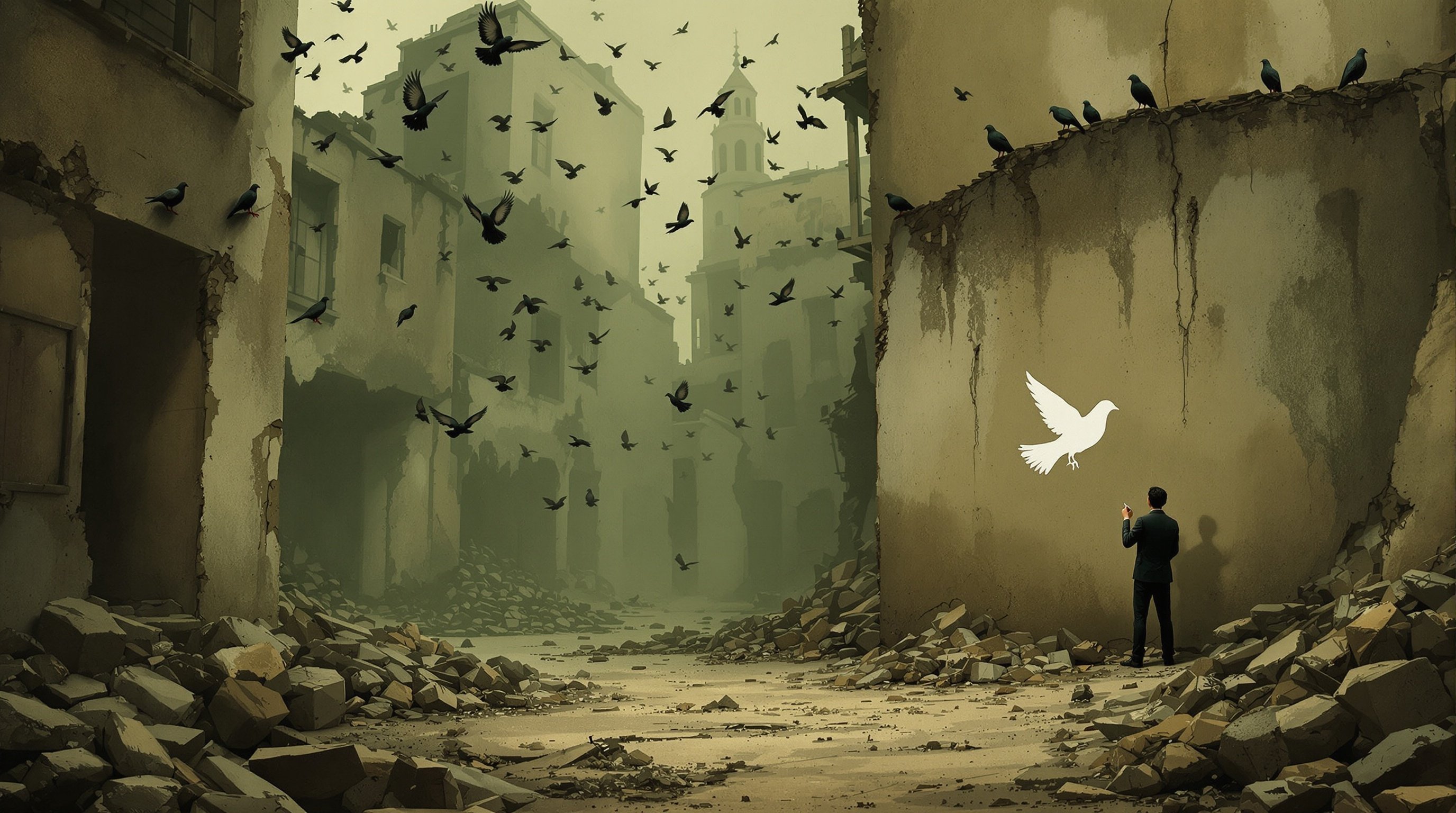
We were drawing bird pictures on walls, and the next day, someone would come and paint over them. Neither we nor they ever tired.
Chapter 6
As we continued our protests, three years had passed. My parents had been sentenced to seven years without parole; some received longer sentences, while others were released. Those three years taught us not just romantically but also ecologically what we had lost in the most painful way.
The disappearance of chickens meant humanity lost one of its primary food sources. Global fast-food chains built solely around chicken began closing their branches one by one, leaving thousands unemployed. Ticks, which were eaten by chickens, started seeking new hosts. Many plant species experienced population declines as birds, which carried male gametes to female gametes and enabled sexual reproduction, vanished. Without their droppings, the soil became less fertile. Pests and rodents began to multiply uncontrollably.
In short, the balance of nature was frighteningly disrupted. Despite all this, the investigations seemed to be conducted just to placate us. Slow and fruitless.
Chapter 7
It has been exactly twelve years since all this began. The birds have been gone for twelve years. I got married and even had a daughter. We’ve all adapted to the new world order in one way or another. While battling reptiles and insects, we’re also searching for solutions for extinct plant species. We’re building new pest control systems, fortifying the walls and windows of our homes. Building bigger and higher walls.
Additional Chapter
Some nights, we still go out and draw bird pictures on walls. Some are erased before morning. Some last a day or two. Sometimes no one notices. Sometimes little children ask, "What’s this?"
One night, I went out and drew a large pigeon in memory of Selim Abi in a narrow alley. Just as I was about to turn and run, I swear I heard a faint but very real sound of wings for a brief moment. I collapsed onto the pavement and cried.
—deri