The Slope of Zevahir
The Slope of Zevahir
This place used to be a field; now it’s a five-story building. They turned the shop on the ground floor into a coffeehouse. Whenever I come to the neighborhood, I sit here and have a cup of tea. The tea always tastes stale and bitter, but it’s become a habit for me. I watch the people passing by on the street and skim through the headlines of a few newspapers. I delay going home as much as I can because every time I stand at the top of that slope, Hüseyin comes to mind, along with that evening.
I’m the child of a teacher. Some think being the son of a teacher is quite prestigious, but for us, things were never ordinary. On the contrary, I was always the loneliest child in school.
I remember it as if it were yesterday: my mother sitting at the kitchen table, arms crossed in front of her, staring blankly at my father. My father, seated across from her, was recounting his conversation with the principal, and my mother was listening with little interest.
“Don’t sulk, woman.”
Whenever my father tried to appease my mother, he would speak in the Niğde dialect. It often worked, but this time my mother wasn’t angry—she was sad. The light in her eyes had faded, her face was sunken. She looked at my father with questioning eyes. My father continued:
“Alright, alright. You already know I wasn’t at fault in that investigation. It was the principal’s meddling.”
“Oh, so you just sat quietly, and the principal came and slandered you, is that it?”
“Did I commit a crime to be slandered? Books, poetry, theater—are these crimes? Trying to broaden children’s horizons, stepping slightly outside this rote education system that dulls their minds—is that a crime? They want us to teach only what they dictate. They say ‘be silent,’ and we’re supposed to comply. Teach about kings and sultans, but don’t mention the oppressed people beneath them. Talk about the discovery of the Americas, but don’t delve into the suffering inflicted on the indigenous people. Explain earthquake types, but skip over the buildings that collapse due to corrupt contractors. Teach basic arithmetic, but don’t speak of poverty. Sure! For heaven’s sake, don’t you start saying this too.”
My mother shrugged. My father slowly stood up, adjusted his chair, and walked to the door. He stopped just before stepping out, speaking over his shoulder without looking at her:
“We’re moving to another city.”
“Call it exile, why don’t you. I won’t go. I swear I won’t go with you again. Adil! Look, Adil, this is the last time. You should be grateful the child is small; otherwise, I wouldn’t stay a minute—I’d divorce you.”
That day, my father left the house without saying another word. He came back after I had fallen asleep. Even after all these years, whenever I think back to that day, my heart aches. I’ll never forget my mother’s sorrow or my father’s bitterness.
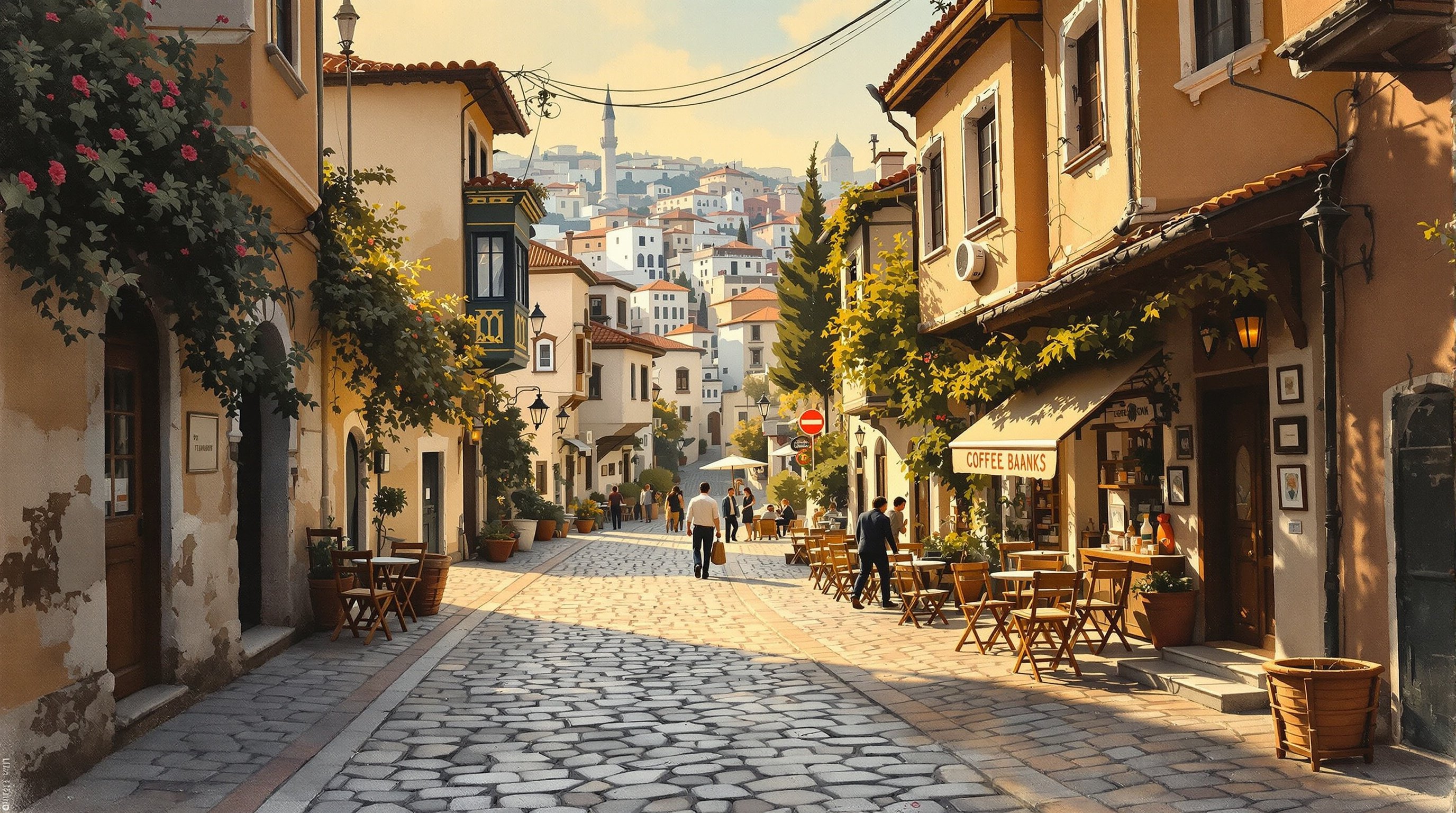
Then we moved here. To the Slope of Zevahir. Zevahir is a neighborhood built along a narrow, steep slope, lined with buildings no taller than three stories. The twenty buildings on each side are all very old, most of them without plaster, paint, or maintenance. Women hang their laundry on their balconies. The street always smells of food, mostly onions.
My school, my friends, my street—everything I loved and hated was left behind. They immediately enrolled me in my father’s school. It was a small neighborhood elementary school, a little further down the slope. All neighborhood schools are similar, especially the children. Their uniforms are either too small, handed down from older siblings, or too big, to be worn next year as well. The boys always have short hair, the girls have braids, and they all smell the same. They dream the same dreams and mostly eat the same meals at home. Who knows? If I hadn’t known we might move again, if I could have made friends, maybe I would have been like them. But I never was. I just went to school and came back, sometimes watching the children outside from the window. And then there was him. The man at the top of the slope. Hüseyin, Lame Hüseyin.
Lame Hüseyin—I never knew when he came to the top of Zevahir, when he went home, when he ate or drank. He was there in the morning, in the evening, at all hours of the day, as if nailed to that spot at the top of the slope, never speaking to anyone. I was terrified of him. It seemed like he could touch the second floor of a building with an outstretched hand or carry a car on his back. His stern gaze held no trace of mercy. I thought he was a monster. When I told my father this, he scolded me. “He caught my attention too. The neighborhood is full of tough guys like him, Ulaş. Still, it doesn’t suit us to think this way. We should see if we can win him over,” he said. My father was always like that. He believed he could win people over, fought for it, and in the end, he always lost. Hüseyin was just that: the neighborhood thug, with his prayer beads in hand, standing at the top of the street all day, casting an intimidating shadow.
After our conversations, my father asked a few people in the neighborhood about Hüseyin. All he learned was his name and that he lived with his mother. No one had ever seen him talking to anyone. They had lived here for years, but the mother and son were reclusive.
One morning, as we were passing by, my father greeted Hüseyin. We were on our way to school. He was at the top of the street, as usual. “Good morning,” my father said. I clung tightly to his hand, pressing myself under his coat. Hüseyin didn’t even respond, just rolled his eyes and looked away. Oh! I thought to myself. Now my father will give up and stop bothering with this man. But my father had a sweet smile on his face at that moment. I understood what he was thinking a few days later.
We were returning from school. My father’s steps slowed, but as we approached Hüseyin, he started walking more upright. He stopped right in front of him. To me, Hüseyin looked like a giant compared to my father. With the same sweet smile, my father took a book out of his jacket pocket. As he handed it to Hüseyin, he began to speak. The whole moment felt like a slow-motion film to me.
“Here, son. I don’t know if you like to read, but this is one of my favorite books. I thought you might enjoy it. My name is Adil. I’m a teacher at the school down the street. We just moved here, though I’m sure you’ve noticed. If you like it, I can bring you more books. I have plenty.”
I stood frozen in place. Hüseyin looked at my father with a blank, unpleasant expression. No thank you, no curse, no reaction at all. My father patted my head and smiled as he continued.
“This is Ulaş, my son. He’s in elementary school. Anyway, take care. We’ll see you around.”
I was furious with my father. How could he mention my name? How could he be so friendly to someone who wouldn’t even speak to him? If my mother found out, she’d be furious with him. She had agreed to move one last time with my father. If he got into trouble again, they would separate. I didn’t want that at all, so I kept quiet. Maybe, deep down, I didn’t want my father to be upset.
A few days passed. My father was more restless at school than ever. I had never seen him so tense. Children can be cruel; they quickly judge and condemn. I overheard them talking about how their parents had complained about my father. Some were swearing, others making threats. This city was unlike any other. Even I could see that.
One day, as we were walking home from school, a man dressed in black approached us. My father pushed me slightly behind him. He stood motionless, facing the man. The man spoke first.
“Teacher! You don’t know these parts. Don’t get yourself into trouble. Look, you have a child too. If I were you, I’d pack up and leave. If you’re smart, you’ll go.”
My father calmly asked, “Or else?”
“You’ll see, teacher. I’m just warning you. Do what you will.”
The man brushed past my father with a shoulder bump and walked away. I was nearly shaking with fear. My father, however, said nothing, took my hand, and started walking. He let out a deep sigh. He was trying to appear brave, but he didn’t realize he was talking to himself.
“What do I do now? Should I gather my family and leave? No, she won’t come; she swore she wouldn’t. What do I do now? Should I confront them, tell them to do whatever they want and be done with it? No, I can’t. Ulaş is here.”
He fixed his gaze on the slope as if he had found a great solution.
“Hüseyin! Lame Hüseyin! I know it all started with you. I just gave you a book, damn it. To read, to become a better person. Hüseyiiin! Ah, Hüseyin. Books shouldn’t kill people; people shouldn’t die because of books. Children should read; everyone should know the truth. Ah! She swore she wouldn’t come.”
We were almost home when he pulled himself together. Even the slope couldn’t leave him breathless this time. We spoke little at the dinner table, and then I went to bed. I had never struggled so much to fall asleep. I had nightmares all night, waking up drenched in sweat. In the morning, the ashtray was overflowing with cigarette butts, and my father was in the kitchen.
The following days were no different. We spoke little, ate little, slept little. Lame Hüseyin remained in the same spot. At the top of the slope. As soon as he saw us from afar, he fixed his gaze on us and didn’t look away until we entered the house. My father gripped my hand tighter and took larger steps. I kept glancing back at Hüseyin. Seeing him frown, how he focused on us, how he clenched his prayer beads in his palm, I quickly turned my head forward. My mother was unaware of what was happening. We, however, were crushed under a great unknown, two confidants. We didn’t have to wait long. That dark night, it happened.
When my father said he had some work to do at school and would be home late, I didn’t want to go home alone and told him I’d stay at school with him. By the time we left school, it was completely dark, and the streets were deserted. As we approached the slope, we saw three burly men coming toward us. They had thrown their black coats over their shoulders, hands behind their backs, grinning as they walked. My father hesitated between stopping and walking. I clung tightly to his arm. My heart was pounding in my chest. The men came right up to us and stopped. The one with the deep voice and large build looked at my father and said:
“We warned you, teacher, but you didn’t listen. You didn’t leave.”
It was clear my father was trying to stay calm.
“Look, boys, there’s no need for this. I’m a teacher; I’m not anyone’s servant. And what have I done to deserve being told to leave? If I left every time someone like you told me to, well... Who do you think you are? Go on, get out of here.”
“Get out of here”—I think that’s what really enraged them. I heard a few curses, then someone mentioned the school. There was shoving and shouting. Someone was yelling constantly. It was the first time I had ever been in the middle of a fight. The voices rose like a roar. One of them, cursing, pulled out something metallic that gleamed in the night. He raised his hand and lunged at my father. There was so much noise that I couldn’t even hear my own scream. I remember crouching down and closing my eyes. I don’t know how long I stayed there. I opened my eyes when a cold, trembling hand touched my shoulder. It was my father who had touched me, and there was no one else around. Only my father, standing frozen, his eyes wide open, his cheeks streaked with tears, staring at the ground. I looked too. A man lay on the ground, covered in blood. I recognized him when I saw the bloody prayer beads in his hand. It was Lame Hüseyin.
The neighborhood turned into a battlefield in an instant—police, ambulances, people running, wailing. I went to the corner where Hüseyin always stood, sat down, and watched everything from there. From Hüseyin’s spot, I watched Hüseyin.
At one point, I turned my head and saw a woman walking toward us with trembling steps, her hands clasped over her stomach, rubbing her palms together. She didn’t enter the crowd; she watched from a distance, crying. A few people from the neighborhood approached her, one of them taking her arm. The Slope of Zevahir was like hell.
Later, they caught those men. It turned out they were the father of one of my father’s students and his friends. In their defense, they mentioned books and said my father had wanted to put on a play for the children. Lame Hüseyin had intervened, the knife had struck him, and he had nothing to do with the incident. Their target had been my father.
Lame Hüseyin spent twenty-five days in intensive care. My father didn’t speak for twenty-five days. My mother emptied ashtrays for twenty-five days. The top of the Slope of Zevahir remained empty for twenty-five days. On the twenty-sixth day, the news of Hüseyin’s death came to our door, along with his mother. Her head was bowed, her hands trembling. Her eyes were dark with exhaustion. My mother silently let her in. She gestured for me to go to my room, but the woman said, “If it’s no trouble, let him stay.” I stayed. After a long silence, she began to speak.
“We were in Ankara. Living in a shanty in Balgat. Rasih—his father—he named Hüseyin. A year before he was born, someone he knew and loved was shot and killed. He said, ‘Let his name be Hüseyin.’ And so it was. My Hüseyin was six years old. I’ll never forget that dark day. Rasih took him to the coffeehouse. It was 1978, a hot day. I told him not to take the boy, but he said, ‘It’s not that kind of coffeehouse; let him come,’ and they went. But I told him not to take him. How could the man have known they’d shoot up the coffeehouse that night? That one of those bullets would take his own life while another would cripple his son? How could I have known? If I had known, I would have barred the door, never let them leave. Within a year, I took my boy and fled here. Poor thing, he watched his father die before his eyes and was left crippled. He never recovered. At first, he used to watch the school from the corner. He never approached the other children. He never went to school, poor thing. He was a frail, skinny boy. Then he grew up, filled out. He clung to that corner. The coffeehouse they were shot in was at the top of a slope in Balgat. Deep down, I know he was always waiting for the killers to return. He had replaced the slope in Balgat with Zevahir. He would look at the school with longing, then at the roads, and in his own way, he protected the neighborhood.”
The woman was crying, and so were we. She straightened up a bit, reached into her vest pocket, and pulled out the prayer beads I knew so well. She looked at them for a long time and sighed deeply. Then she knelt before me, placed one hand on my knee, and with the other, put the beads in my palm.
“These prayer beads belonged to Rasih’s father, then to him, and when he died, they were all Hüseyin had left. Before he died, he sent them to you through me, and he said: ‘Children need their fathers, and fathers need their children. I saved his father. He won’t be fatherless like me, mother.’”
Hüseyin’s mother had come to me. Hüseyin, Lame Hüseyin, had sent her. To see me one last time. To help me grow.
After that day, it was hard for us to recover. My father and I went to school and came back, seasons changed, years passed. Whenever we came to the top of the slope, my father would nod slightly, so imperceptibly that no one else could see it. Only I noticed, only I knew. My parents never moved away from Zevahir; they always loved it. Only I grew up and left them.
Now, whenever I come to this neighborhood, I drink a bitter tea facing the slope. I nod slightly to Hüseyin’s absence. No one sees it. Only I know.
deri